Beauty as a Spiritual Experience
The concept of beauty as a spiritual experience closely relates to Plotinus’ philosophy of beauty— the idea that art can help the mind draw connections to the spiritual aspects of life and nature. If an individual can look upon artwork and relate to it in some way that makes them experience happiness, be reminded of something positive, or recall an event or positive emotions from past experience, they have experienced a spiritual form of beauty.
The Shaker movement of the early 1800’s produced some of the best American design. Their concept of beauty rings true with this idea of a spiritual beauty—a beauty deeper than the surface appearance. In the book “Shaker Built” by Paul Rocheleau and June Sprigg this idea of beauty is expressed as follows:
“The appearance of things—including buildings—mattered in the Shaker world, but not in the same way that it generally mattered in the World…Physical homeliness was perhaps less of a handicap in the Shaker world than anywhere else because the beauty of the spirit was what was deemed important.”
In the Shaker world, the appearance of a thing or person mattered only to the extent that it revealed the underlying function. Whatever did not interfere with function, served the function.
S.N. Nasr in an essay titled “The Interior Life in Islam” discusses the role of beauty as a requirement for spirituality, and a necessary element for survival.
An understanding of the interior life in Islam would be incomplete without reference to the imprint of the Divine Beauty upon both art and nature. Islamic art, although dealing with a world of forms, is, like all genuine sacred art, a gate towards the inner life. Islam is based primarily on intelligence and considers beauty as the necessary complement of any authentic manifestation of the Truth. In fact, beauty is the inward dimension of goodness and leads to that Reality which is the origin of both beauty and goodness. It is not accidental that in Arabic moral goodness or virtue and beauty are both called Husn. Islamic art, far from being an incidental aspect of Islam and its spiritual life, is essential to all authentic expressions of Islamic spirituality and the gate towards the inner world.
From the chanting of the Holy Quran, which is the most central expression of the Islamic revelation and sacred art par excellence, to calligraphy and architecture which are the “embodiments” in the worlds of form and space of the Divine Word, the sacred art of Islam has always played and continues to play a fundamental role in the interiorization of man’s life.
Nasr puts art and beauty as being “central” and “fundamental” to spirituality. There may be one type of beauty which is purely scientific and instinctual, and there may be another which breaks the boundaries of scientific description and can only be fully appreciated and understood when it is looked at holistically and takes into account the spiritual and metaphysical aspects of humanity.
Gordon B. Hinckley—former spiritual leader of the Church of Jesus Christ of Latter-day Saints—spoke of beauty in the following manner:
“…I believe in the beauty of nature, and I see and believe in the beauty of animals. I see and admire beauty in people. I am not so concerned with the look that comes of lotions and creams, of pastes and packs as seen in slick-paper magazines and on television. I am not concerned whether the skin be fair or dark. I have seen beautiful people in all of the scores of nations through which I have walked. Little children are beautiful everywhere. And so are the aged, whose wrinkled hands and faces speak of struggle and survival…”
His statement addresses an aspect of spiritual beauty, that of being able to look past superficial qualities toward an inner beauty, finding conditions in the “wrinkled hands and faces” that communicate to us in ways more profound than our visual perceptions.
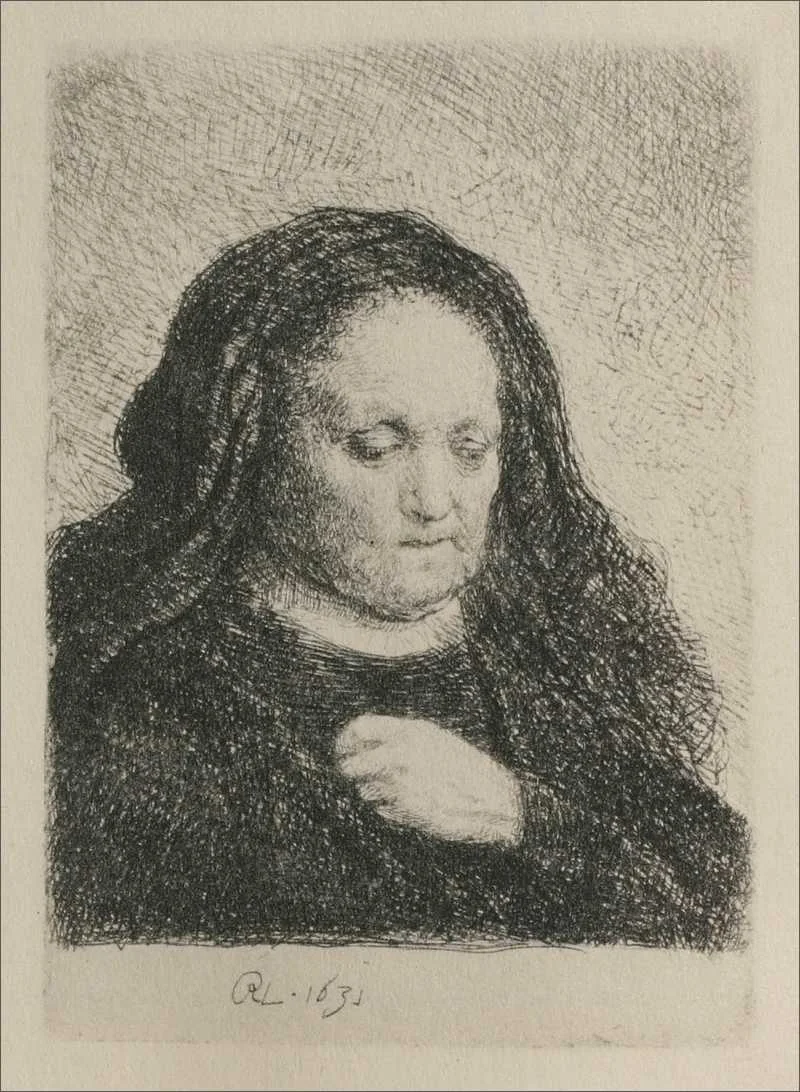
Portrait of an Elderly Woman by Rembrandt van Rijn (1606–1669). Rembrandt believed that the faces of the elderly told the most exciting stories of life. His drawings reveal the poetry and beauty of old age.